Frank Phillips
Killers of the Flower MoonFrank Phillips was a wildcatter and a leading oilman whose repeated appearances in Pawhuska connect the physical drama of drilling with the auctions that allocated Osage oil leases. The book presents him as a figure of the boom’s spectacle and competition: he was among the men arriving in luxurious railcars, bidding for valuable tracts, and sometimes competing so fiercely that business rivalry became a physical fight. His prominence belongs to a larger history in which oil brought immense wealth to the region while control of its benefits remained sharply contested.
Identity and the well on Lot 185
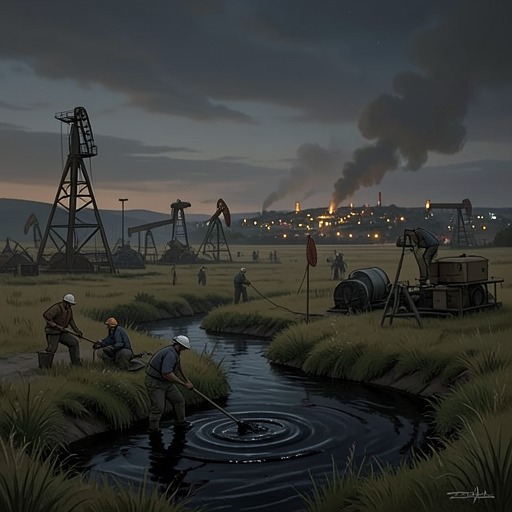
Before becoming associated with oil, Phillips had sold a tonic advertised to prevent baldness. In the spring of 1917, he was out with workers on Lot 185, less than half a mile from Lot 50, where they were drilling from a platform. The scene turns suddenly from routine work to danger: the derrick trembled, a rumbling and gurgling came from below, and the workers ran as the sound grew into a roar. A driller pulled Phillips from the platform just before the earth burst open and a column of black oil shot into the air. The episode makes him part of the boom at its most elemental—not only a magnate arriving after the fact, but a wildcatter present at the moment underground oil announced itself violently at the surface.
The well’s eruption also helps explain why oil wells became public spectacles. A gusher was not simply a source of production; its sudden force could make the land itself seem to break open. Phillips’s narrow escape places human bodies beside that power: the driller’s quick intervention saves him just as the oil erupts. The book’s account of the scene gives the boom both its promise and its danger, before the figures and lease prices that would later define it come into view.
Oil wealth and the rush to Pawhuska
The gushers drew Osage spectators, who watched oil rise fifty, sixty, and sometimes a hundred feet into the air. Its spray coated fields and flowers and marked the faces of workers and onlookers; people nevertheless celebrated, hugging and tossing their hats. The image holds together the boom’s competing meanings: oil could appear beautiful and festive, even as the black spray resembled an angel of death. Phillips’s drilling world was part of this shared spectacle, though the excitement of discovery did not mean that the benefits or risks of the industry were shared equally.
The oilmen’s recurring arrival made that new economic power visible in town. About every three months, at ten in the morning, Phillips and other magnates—including E. W. Marland, Bill Skelly, Harry Sinclair, and Phillips’s brothers—came into Pawhuska in private luxury railcars. The press announced their approach with bulletins presenting their visit as a major civic occasion. Their status was not merely personal: they were arriving for auctions through which access to Osage oil leases could be secured, and the local community had been transformed by the money flowing through the oil economy.
The Osage lease auctions
The auctions were held about four times a year under the oversight of the Department of the Interior. They had begun in 1912, but only part of Osage County’s vast underground reservation had been opened to drilling. A single lease typically covered a 160-acre tract, and bidding for these tracts rose to extraordinary levels. A 1923 newspaper comparison suggested that a person trying to spend a million dollars would have found the task easy in Oklahoma: one nod at an auction could commit that sum. The auctions, in other words, converted subterranean resources into highly visible contests over access and wealth.
In good weather, bidders gathered outdoors beneath the Million Dollar Elm, while spectators came from miles away. Phillips was among the oilmen who came to these events; Ernest Burkhart sometimes attended, as did Mollie Burkhart and other Osage people. Newspapers cast the Osage spectators through familiar stereotypes, describing their interest in a way that made them seem detached from the economic event unfolding before them. Yet the auctions concerned their land and its mineral wealth. The presence of prominent settlers, including William K. Hale and Scott Mathis, also showed how the oil economy supported local businesses and ambitions beyond the companies extracting oil.
Rivalry, bidding, and performance
The auctions could turn commercial competition into physical conflict. On one occasion, Phillips and Bill Skelly began fighting and rolled on the ground, while Harry Sinclair nodded to the auctioneer and left with the lease. Their struggle was both comic and revealing: men competing over enormous stakes could be reduced, in the press’s vivid account, to a melee, while a rival secured the prize through a gesture and timing. Phillips’s prominence did not place him above the contest; he was one of its conspicuous participants.
Bidding also depended on signals too slight for most observers to notice. Phillips and one of his brothers used an almost imperceptible raised eyebrow or flick of a cigar to communicate. Phillips joked that his brother had once cost them $100,000 by swatting a fly. The anecdote gives the auction its finely calibrated theatricality: a movement small enough to be mistaken for an involuntary gesture could alter a bid by a fortune. Against the roar of the gushers, this was another kind of control over oil—quiet, practiced, and exercised at the moment a lease changed hands.
Wealth, extraction, and what the account leaves unresolved
The book sets the oilmen’s prosperity beside the exploitation enabled by the Indian guardianship system. White’s investigation found that some guardians and administrators used their positions to inflate prices, direct their wards’ business for kickbacks, claim property for themselves, or steal outright. A government study estimated that at least $8 million had been taken directly from restricted Osage accounts before 1925. This account describes a broad network involving prominent citizens and public officials; it does not establish that Phillips personally took part in those abuses. The distinction matters: his role in the auctions and oil boom is documented, but proximity to a corrupt system is not evidence of personal participation in every part of it.
The boom’s wealth also proved vulnerable to depletion and falling prices. By the Great Depression, Osage fortunes had been diminished by guardians and thieves as well as by the collapse in oil prices; a barrel that had brought more than three dollars fell to 65 cents in 1931, and an annual headright payment dropped below $800. Gray Horse and other boomtowns later declined, while thousands of remaining wells produced at much lower rates. These later changes are not presented as Phillips’s personal ending. They instead place the commercial world in which he prospered within a longer arc: spectacular eruptions and high-stakes leases gave way to diminished production, reduced income, and settlements altered by the uneven distribution of oil’s rewards.